A Three-Pass Reading for a Story Still Unfolding
A three-pass reading for developing news separates supported details from unresolved claims, so you can judge what an account establishes and where it stops.
The common mistake with developing news is to treat an article’s confident tone as proof that every claim has the same footing. The cost is a blurred distinction between what a source says, what a document records and what the article can establish. A three-pass reading for developing news helps keep those categories apart before you decide what the account actually supports.
This routine concerns the evidence and framing within one account, not the mechanics of following updates. Choose a report about a public announcement, a court hearing or a local incident. Keep the article and any linked material distinct: a link may add evidence, but it does not become part of the article merely by sitting beneath it.
Separate the claims
Read the article once and identify its central claims. Then break each broad sentence into smaller ones. “The council issued a notice, and the road will close” contains a claim about an official act and a separate claim about what will happen. The first may be established by the notice itself; the second depends on what the notice says and whether the article represents it accurately.
For each claim, note its wording and the basis given in the account. The basis could be a quoted document, a named person’s statement, a reporter’s observation or an unnamed source. Do not treat those forms as interchangeable. A document can establish what it says, while an attributed statement establishes that someone made the claim—not necessarily that the claim is true.
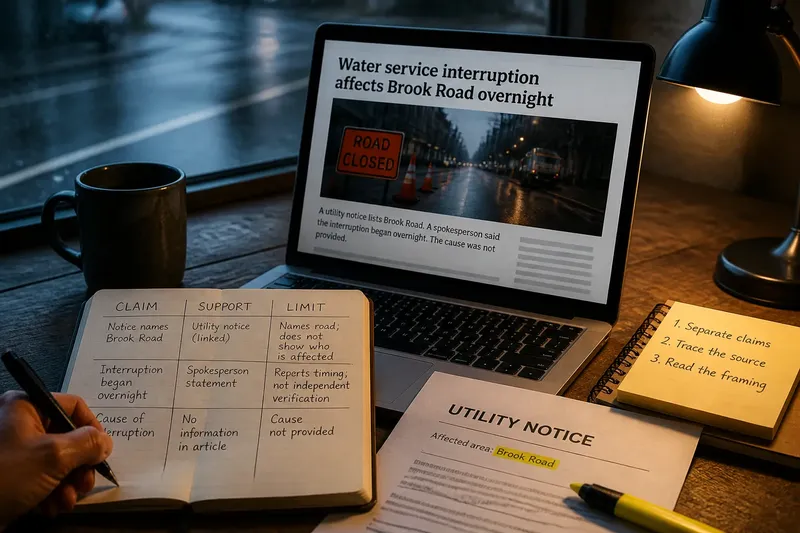
Use a small table or note with three columns:
- Claim: write the narrowest precise statement the article makes.
- Support: identify the source or evidence the account gives.
- Limit: state what that evidence does not establish.
Check each entry against the text. If the article says a notice names Brook Road, record that the notice names Brook Road. Do not silently widen it to “Brook Road is affected” unless the notice or another cited source supports that claim.
Trace the source
Follow a link when it leads to evidence needed to assess a central claim, such as an official notice, court document or full statement. Read the relevant passage in the source itself, not only the article’s description of it. Record the source’s title or issuing body and whether the article quotes it directly, paraphrases it or links to it without explaining its contents.
Attribution deserves its own attention. “The utility said the interruption began overnight” reports what the utility said. It does not independently establish when the interruption began. “A notice issued by the utility lists Brook Road” is narrower: the notice can support what it lists, but not necessarily the full extent of the interruption.
When a source is unavailable or only partly quoted, mark that limit rather than filling it with inference. An absent link is not proof of a false claim; it is a reason to describe the support as unavailable in the account.
Say you read a fictional local report about a water-service interruption. It says a utility notice names Brook Road, and quotes a spokesperson saying the interruption began overnight; the report gives no cause. Your note would distinguish the notice’s contents from the spokesperson’s account of timing, and leave the cause unsupported. The resulting picture is narrower than a headline suggesting the cause and extent are settled, but it is also more faithful to the material provided.
Read the framing
Framing is often visible in the choices around a claim: which detail leads, which voices appear, and which uncertainty is placed in the background. A headline may compress an attributed statement into a categorical assertion. The body may restore the attribution several paragraphs later. Read both, but do not let the headline’s grammar replace the body’s evidence.
Look for distinctions the wording can obscure:
- If a figure or event is attributed to a source, keep that attribution attached to it.
- If a document records an allegation, do not rewrite the allegation as an established event.
- If an account names one affected location, do not infer that it is the only location.
- If a report says it has no answer, distinguish that from evidence that no answer exists.
- If a person is described with a loaded label, check whether the article supports that description or merely repeats someone else’s wording.
- If a claim appears only in a headline or caption, check whether the story supplies support for it before treating it as established.
Each item calls for a decision, not a verdict on the outlet. If the source is attributed, retain the attribution; if it is missing, mark the basis as unclear. If the article supports only a narrow statement, record that statement rather than the broader implication. If a loaded description is unsupported, treat it as framing rather than evidence.
What can the account establish?
Does attribution prove a claim?
No. Attribution shows who made a claim, while the claim’s truth may require separate evidence. Record the speaker and look for any independent support the article provides.
What does a linked document establish?
It can establish what the document says and, where clear, who issued it. It does not automatically establish that every statement inside it is accurate or that the document covers matters beyond its stated scope.
How should I treat missing information?
Mark whether the article says the answer is unknown, leaves the question unaddressed or lacks evidence for a claim. Those are different limits; none licenses an invented answer.
What if the headline is broader?
Use the body and cited evidence to identify the narrowest supported claim. If the headline goes further, note the difference rather than importing its stronger wording into your account of the evidence.
Apply the distinction
Imagine the fictional water-service report’s headline says “Brook Road residents face overnight outage”, while its body only says a notice lists Brook Road and a spokesperson says the interruption began overnight. Take these steps:
- Write down the headline’s claim: residents on Brook Road face an overnight outage.
- Separate its parts: the location, who is affected, and the timing.
- Check the cited notice. In this invented scenario, it lists Brook Road but does not identify residents or addresses.
- Check the spokesperson’s statement. It gives the reported start time but says nothing about who is affected.
- Compare support with wording. The location is supported as a place named in the notice; the timing is attributed to the spokesperson; the claim about residents is not established by either source.
- Record the resulting account: “The notice names Brook Road; a spokesperson says the interruption began overnight; the report does not establish which residents are affected or why.”
The answer is not that the headline must be false. It is that its wording reaches beyond the support described in this invented account. That distinction lets a reader remain precise without pretending to know more than the article provides.
Keep a claim note
A compact record is enough to preserve the distinctions:
- Exact claim: if the wording is broad, split it into separate claims; if it is already precise, keep it intact.
- Source named: if the article identifies a speaker or document, record that name; if it does not, mark the source as unspecified.
- Evidence available: if the source is linked or quoted, inspect the relevant part; if it is not available, mark that limit and do not infer its contents.
- Attribution: if the claim belongs to a named source, retain the attribution; if the article presents it as fact without showing support, mark the basis as unclear.
- Scope: if evidence supports only a place, statement or allegation, keep the note to that scope; if the article supports a wider claim, record the additional evidence it supplies.
- Unanswered point: if the article identifies an unknown, label it as unknown in the account; if it simply omits the matter, label it unaddressed rather than assuming nobody knows.
For developing news, the value of this three-pass reading lies in disciplined limits: separate claims, inspect their sources, then examine how the wording frames what remains. The main search phrase, “three-pass reading for developing news”, describes a way to read carefully, not a promise that every account will answer every question. When the evidence stops, let the claim stop there too.