What a Photograph Can Prove, and What It Cannot
Learn what a news photograph can establish, what remains uncertain, and how to check its date, location and context before accepting a larger claim.
The common mistake with a news photograph is treating a visible detail as proof of the whole caption. A photograph can show a person beside a damaged vehicle; by itself, it may not establish when the image was made, where the vehicle is, what caused the damage or what happened before the shutter clicked. Confusing those claims can turn a useful record into a misleading account.
The remedy is not to dismiss photographs. Separate the visible observation from the story attached to it, then ask what further evidence would support each part. A careful reader can do this without specialist software, though some claims need verification beyond the image itself.
Claim exceeds the frame
A photograph records a scene from one position and at one moment. The camera’s frame leaves out whatever was beyond its edges, while the shutter leaves out what happened before and after. Cropping, selection and a caption can narrow the viewer’s attention further.
That makes a distinction useful: “The image shows a cracked window” is an observation. “The window was cracked during last night’s protest” adds a time and cause. “Protesters broke every window in the building” adds a broader claim about people and events. The photograph may support the first sentence while leaving the others open.
Start by writing down the smallest claim the visible details actually support. Describe objects, people, signs or damage without assigning motive or cause. Then compare that sentence with the caption. Any extra claim needs evidence of its own.
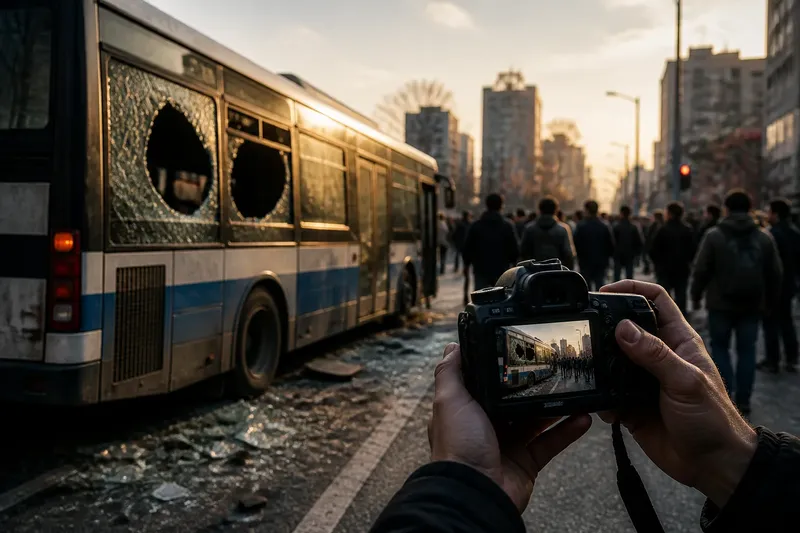
Say you see a photograph of a bus with a shattered side window, posted with the claim that a particular crowd attacked it. The image supports the observation that the window is broken. To assess the attribution, you would need reliable information linking that bus, the relevant time and place, and the people shown or described. A crowd in the same frame is not, on its own, evidence that its members caused the damage.
Date is uncertain
A photograph can look current while being old. A post’s publication date tells you when that post appeared, not necessarily when the image was taken. An old image may be recirculated during a new event, sometimes with a caption that quietly changes its meaning.
Look for clues that can be checked against the claimed date: seasonal clothing, weather, visible construction, shop signs, vehicle markings or a banner naming an event. These clues can help establish whether the caption is plausible, but a single clue rarely settles the question. Snow does not provide a calendar, however persistent it may seem.
Search for the image or distinctive portions of it using a reputable reverse-image search service. Results may reveal earlier appearances or versions with different captions. Treat the earliest result you can locate as a lead, not automatic proof of the original date: search services do not necessarily index every appearance, and reposts can lose their publication history.
When possible, compare the image with material from an identifiable news organisation, official account or photographer’s original post. Check whether that source states when the photograph was made, rather than merely when it was published. If no dependable date can be established, say so in your own assessment instead of borrowing certainty from the caption.
Location does not match
A recognisable landmark can help place a photograph, but lookalike streets, buildings and landscapes are common. A caption may name a town while the image comes from elsewhere, or it may describe a broad region that the frame cannot distinguish.
Check visible place names, road signs, distinctive architecture and terrain. Compare them with maps or other images of the named location, paying attention to the angle and surrounding features rather than one familiar-looking façade. If a photograph contains a sign, consider whether it could have been moved, covered or captured outside the place the caption claims.
Digital metadata may include location information, but it can be absent, stripped when an image is shared, or unreliable. It may help when its origin and handling are clear; it does not turn an image into a complete travel log. Do not treat a blank metadata panel as evidence that the location is false.
If the setting cannot be pinned down, narrow the wording. “A street scene said to be in the city” is more accurate than naming a neighbourhood without support. Accuracy is not obliged to provide a postcode.
Cause is assumed
Damage, smoke, a crowd or an object on the ground can be visible without revealing how it got there. A still image often records the result of an event while leaving the cause outside the frame. Captions can fill that gap with a plausible explanation, but plausibility is not confirmation.
Ask what other evidence would distinguish competing explanations. For a fire photograph, that might include a statement from the fire service or reporting that identifies the site and describes what is known about the cause. For a damaged vehicle, a time-stamped sequence or a reliable account from someone positioned to observe the incident may add context. The image should not be asked to supply details it does not contain.
Be cautious about visual details that seem to settle responsibility: a person near a broken object, a uniform, a flag or a tool. Presence is not necessarily participation, and a photograph may omit the actions that matter. Verify the link between the person and the event rather than inferring it from proximity or appearance.
Context disappears
A crop may be accurate as far as it goes and still distort what the scene means. It can exclude a sign explaining a demonstration, other people standing nearby, or the object that makes a gesture intelligible. A photograph’s selection can also imply that one moment represents an entire event.
Look for the uncropped version, a sequence of frames or a video from the same scene. Check whether a photographer or newsroom identifies the image as a selected moment and whether neighbouring frames change what is visible. More material can clarify the scene, although it still represents only what was recorded from those positions.
Ask whether the caption describes a specific moment or generalises from it. “A person holds a placard” is narrower than “the crowd demands a particular policy”. The second claim may be supported by interviews, signs across the gathering or other reporting, but one placard cannot speak for everyone present.
Photograph verification questions?
Can a photograph prove who took it?
Not usually from appearance alone. An original post, a credit from a news organisation or a clear chain of attribution can identify a photographer, but an image copied without its source leaves that question unresolved.
Does reverse-image search verify a caption?
It can locate earlier copies or related images, which may expose a recycled photograph or offer leads for checking. It does not independently confirm the date, place or cause in a caption.
Can a photograph prove a person’s intent?
A still image can show visible actions, but intent is an interpretation of why someone acted. That requires context such as a sequence, direct statements or corroborating reporting, not a guess based on facial expression or position.
What if the original image is unavailable?
Use the source trail and independent reporting that can be checked, while noting what remains unknown. If the claim depends on details hidden by a crop or missing from reposts, avoid presenting those details as settled.
Photograph verification checklist
Use this checklist to separate what the image visibly supports from what still needs corroboration. Each observation should lead to a choice about how narrowly to state the claim.
- Check whether the caption names a date and whether the original post or a reliable source identifies when the image was made; if the dates agree, retain the supported date, but if they do not or remain unclear, describe the date as unverified.
- Check visible signs, landmarks and terrain against the named location using a map or other images; if several details align, state the location with suitable caution, but if they conflict or are too generic, omit the precise place name.
- Check whether a reverse-image search finds earlier copies with different captions; if an earlier appearance is identifiable, treat it as a lead and compare its source, but if results are absent or inconclusive, do not infer that the image is new.
- Check whether the available image is cropped by looking for an uncropped version or neighbouring frames; if the wider scene changes the apparent action, use the fuller context, but if no fuller version is available, avoid claims that depend on what lies outside the crop.
- Check whether the caption attributes damage or an action to a person; if independent reporting or a sequence links that person to the event, describe the attribution with its source, but if only proximity is visible, state presence rather than responsibility.
- Check whether the claimed cause is visible or supported by an identified source such as a fire service statement; if a source addresses the cause, attribute that account, but if the image only shows an outcome, describe the outcome and leave cause open.
- Check whether the photographer or original source can be traced through a credit, original post or clear attribution; if the trail is coherent, credit that source, but if the image is detached from its origin, say the photographer is unknown rather than guessing.
Say you encounter an invented post showing a damaged shopfront, captioned as damage caused by a demonstration in a named town that morning. The starting inputs are the repost, its caption and the image, which contains a shop sign but no clear date. First, you search the image and find an earlier copy with a different caption; that makes the new date uncertain, not disproved. Next, you compare the sign and surrounding street with map imagery, but only the shop name matches and the street does not clearly align, so you withhold the town attribution. Then you look for an uncropped version and independent reporting about the damage; neither supplies a reliable link between demonstrators and the broken glass. The resulting wording is limited to what the inputs support: the image shows a damaged shopfront, while its date, location and cause remain unverified. The trade-off is less dramatic wording in exchange for a claim that does not outrun its evidence.
State the limit
A useful assessment names both what the image supports and what it cannot settle. For example: “The photograph shows a damaged shopfront, but the available image does not establish when it was taken or who caused the damage.” This is not evasive wording; it tells the reader exactly where the evidence stops.
Keep the photograph and the claim separate in your notes. For each element—what is shown, when, where, why and what happened around it—record the evidence that supports it. If a claim rests only on the caption, say that plainly.
For photograph verification, describe the visible scene narrowly, then check each added claim against evidence suited to it. A photograph can be a strong record of what entered its frame. It is not a witness to everything outside it.