How News Updates Change from Bulletin Boards to Feeds
News updates can change as they move from bulletin boards to feeds. Learn to check a post’s source, scope and wording before relying on or sharing it.
The common mistake with news updates is to treat a fresh post as a fresh account of the whole story. That can make an early claim seem settled or leave a correction unnoticed, at the cost of a muddled understanding of what the source actually says. A bulletin board leaves notices in place; a feed makes them easier to revise, and harder to compare.
Fixed notices, changing feeds
A bulletin board is a place. Readers encounter the notices left there, often with older items still visible. A feed is a stream: a publisher can add, amend, reorder or remove material, while a platform decides how much of it appears to each reader.
The difference is not simply speed. A printed notice presents one version; an updateable channel can present several versions without making their history easy to inspect. That changes how readers encounter a claim and how confidently they can describe what the publisher said at a particular point.
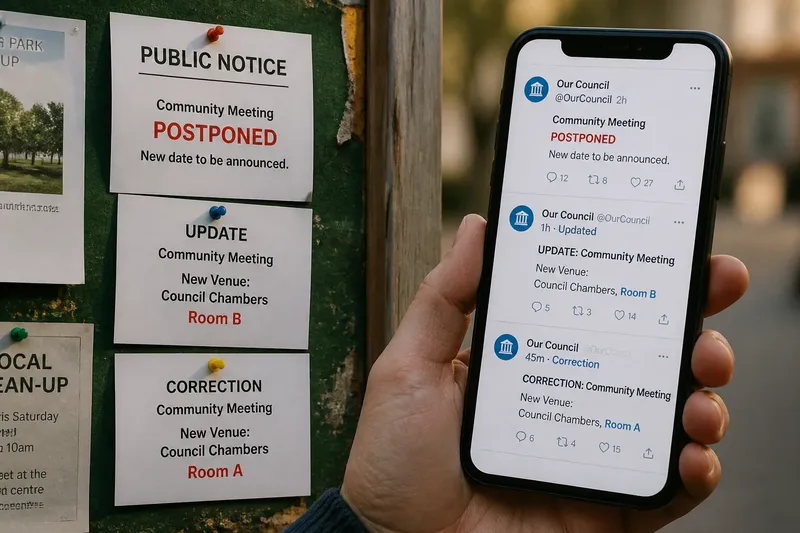
Imagine a council notice board with a paper announcement that a public meeting has been postponed. Someone pins a second notice with the new venue, then replaces it after spotting an incorrect room number. The visible papers let a reader compare the versions, though the board may be untidy. In a feed, the original post might be edited or followed by separate messages, so a reader who sees only one may miss either the postponement or the correction.
Check which version you are reading and whether the channel shows its history.
Why feeds obscure provenance
A feed often presents what is available now rather than every prior version. The publisher controls what it publishes or edits; the platform controls much of the order and presentation. A reader may arrive through a notification, a repost or a search result, rather than the publisher’s own page.
As a result, people can encounter different versions of the same item. One sees an initial alert, another a correction, and someone else a clipped quotation with no link to either. Each fragment may be copied accurately while still omitting the context needed to interpret it.
Printed notices have their own limitations: they can be cluttered, poorly maintained or inaccessible to people who are not in that place. Their advantage is narrower: older papers may remain visible, making replacement easier to notice. Digital convenience does not itself provide a visible record.
Follow a consequential post to the publisher’s page and look for an update note, an edit history or a link to earlier coverage. If none appears, treat that missing history as a limit on what you can say.
What can an update change?
A newer post may add detail, correct a point or report a later development without replacing everything that came before. The relationship depends on what changed and whether the publisher says the earlier account was amended, withdrawn or superseded.
Some outlets append notes to a live article; others publish separate posts or edit without displaying a history. A platform may show an excerpt that differs from the page it links to. A timestamp can tell you when the channel associates an item with publication or editing, but not what changed or when the underlying event happened.
Compare exact wording where it matters. Ask whether the later item reverses a fact, adds a boundary or describes a subsequent event. If no change note is visible, do not infer that the earlier account was formally withdrawn.
Keep the earlier wording in view when the difference affects your interpretation.
How should corrections be read?
Read a correction for its scope. It should identify what was wrong and what replaces it. A correction to a name or location need not undermine unrelated details; a correction to the central basis of a report may alter how the whole account should be treated.
There is a difference between a correction and an addition. “The meeting is in Room B, not Room D” reverses a detail. “The meeting has also moved online” adds a condition. “The account relied on an unverified report” changes the status of the earlier claims. Read the explanation, not only the label.
Corrections may appear at the bottom of an article, in a reply or in a separate notice that travels less widely than the original claim. If you share the item, link to the revised version and state the relevant correction. When the explanation is vague, leave the cause of the change unspecified.
What do news updates establish?
What does a timestamp establish?
A timestamp establishes the time the channel associates with publication, editing or display. It does not establish when an event happened, when a newsroom first learnt of it or how long the information was checked.
Does a newer post replace an older one?
Not necessarily. It may correct a detail, add a qualification or describe a later event, so compare the wording before treating it as a replacement.
What if the version history is missing?
Use the wording currently available, but do not claim to know how it changed. A screenshot or saved link can preserve what you encountered, though neither proves that it is the only version.
How should a corrected item be shared?
Link to the publisher’s current account and describe the correction or qualification plainly. Avoid forwarding an earlier claim on its own when the changed wording affects its meaning.
How to assess a changing post
- Source: Check whether the post is on the publisher’s own page; if it is only a screenshot or repost, then open the source link, or treat the wording as unverified against the original.
- Version history: Look for an edit label, update note or linked earlier item; if one is present, then compare the versions, or record that the history is not visible.
- Exact change: Identify the words that differ; if a fact is reversed, then treat it as a correction, or classify it as an addition or later development where the original claim remains intact.
- Scope: Check which place, time, people or service the wording covers; if the scope is narrower than a shared summary, then preserve that boundary, or avoid repeating the broader summary.
- Timestamp: Note whether the time refers to publication, editing or display; if the label is unclear, then do not use it to infer when the event occurred, or seek an explicit event time from the source.
- Open questions: Note what the post does not establish, such as cause or extent; if a point remains unanswered, then describe it as unresolved, or leave it out of any account presented as settled.
Say you see a school’s first post stating that its building is closed for the day, then a later message saying afternoon activities will take place at another site. The starting information is the closure notice and the new message; your action is to compare their exact scope and check that both come from the school. The result is that the building remains closed while the afternoon activities have a different location. Sharing only “the school has moved” would blur the distinction, so the better wording preserves both instructions.
Sharing without losing context
A screenshot preserves a slice of a page but may omit its timestamp, preceding post or correction. A copied sentence can lose a qualification; a repost can make an old alert look current. Before sharing, check the current source and include enough context for a reader to understand the item’s status.
Consider the claim your message will carry, not just whether you copied the words correctly. Keep boundaries about place, time and affected groups. “Some services have resumed” does not mean “service restored”, despite the second phrase’s talent for fitting neatly into a headline.
News updates are easier to revise and redistribute than notices pinned to a board, but their history may be less visible. The useful search phrase, news updates, points to a focused habit: identify the source, compare the wording and describe only the change the record supports. When that record is incomplete, say what the current account states and leave the missing history unresolved.